

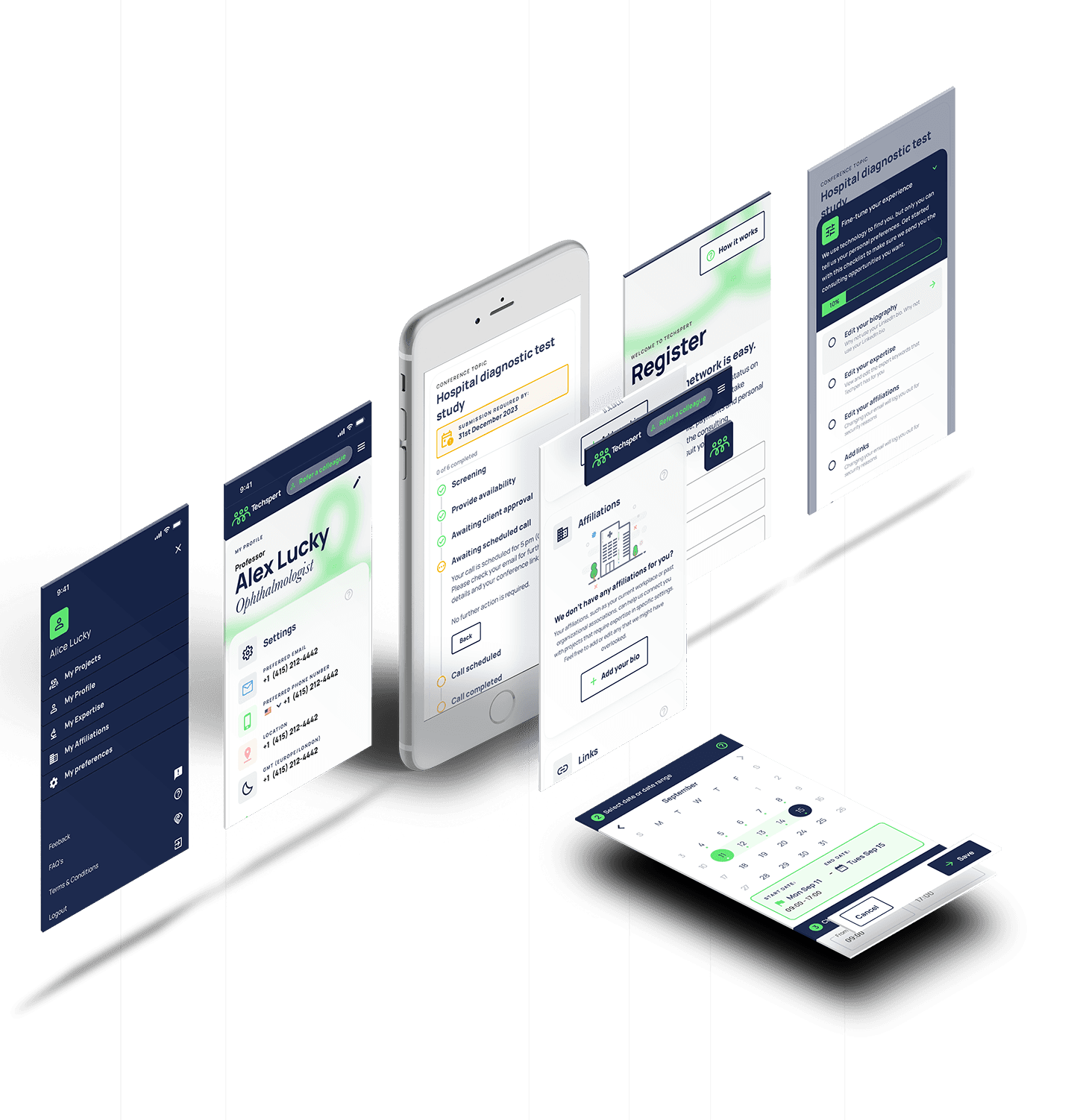
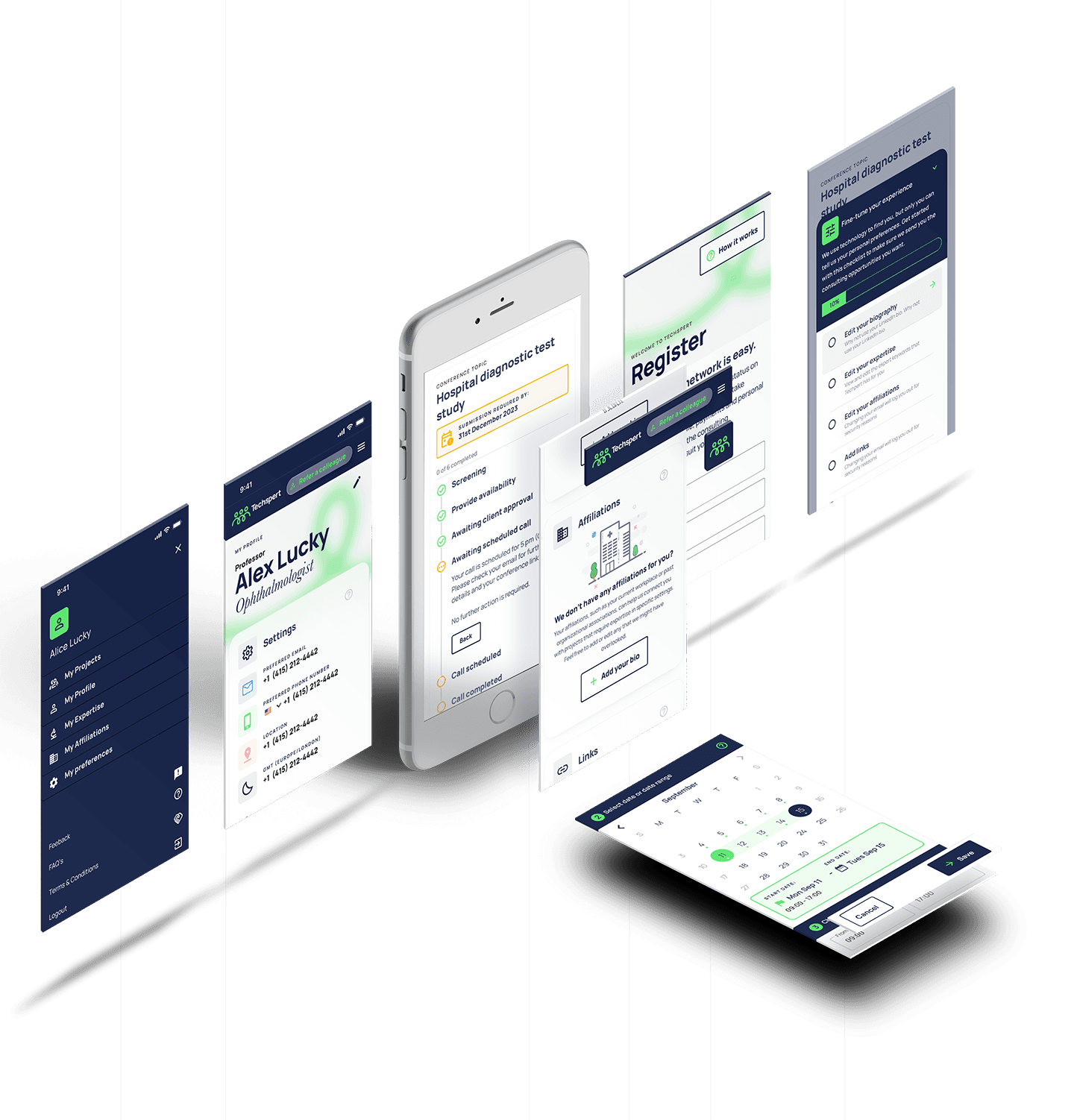

- 3 appsProduct surfaceCustomer, Connect, and Expert portals
- Self-serveExpert modelProfiles, availability, and opportunities
- OKR-ledDelivery rhythmQuarterly objectives with research evidence
The challenge
Manual expert engagement did not scale.
Previously, expert interactions were handled manually via emails in the internal Connect app, requiring project managers (PMs) to facilitate every engagement. My user research uncovered major inefficiencies in this process, leading to a strategic shift: rather than just optimising PM workflows, we built an entirely new self-service Expert Portal, reducing operational costs, increasing efficiency, and streamlining expert-client matching.
A Design Thinking approach
From research into a self-service Expert Portal
In a world where knowledge is power, Techspert harnesses the might of AI to revolutionise the way organisations connect with expert insights in healthcare and life sciences.
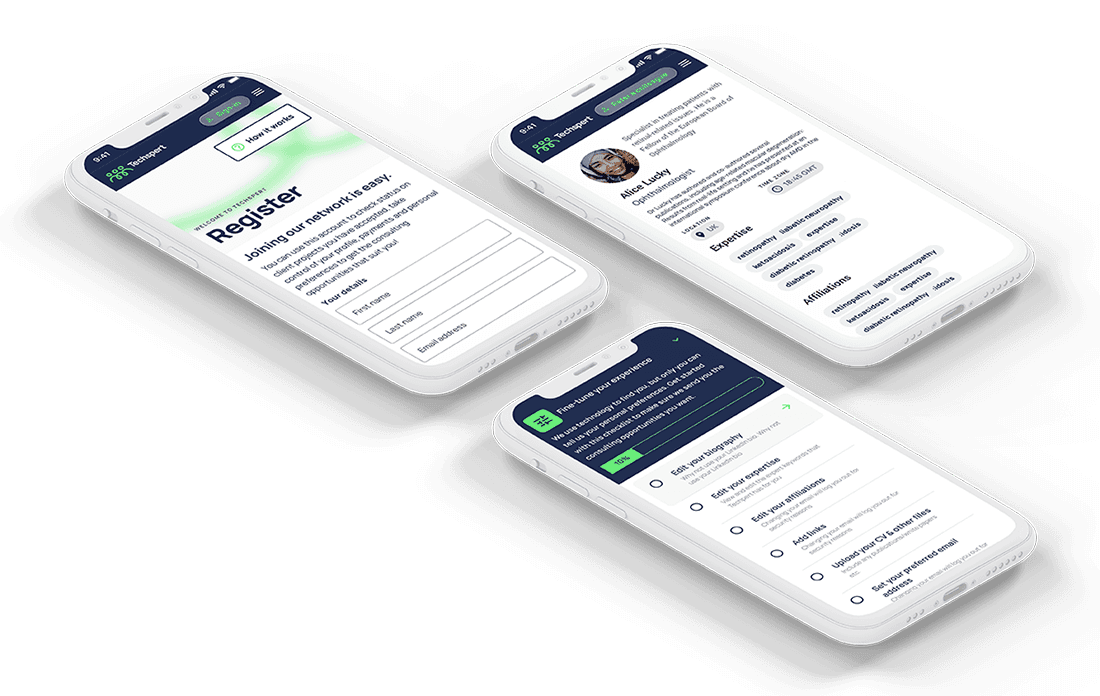
While my work at Techspert spanned across multiple products, including the Customer Portal for client interactions and the Connect Portal for project management administration, my research into the expert's experience led to the creation of an entirely new self-service Expert Portal, allowing experts to manage their profiles, availability, and consulting opportunities in a frictionless and scalable way.
My role and the team
The Expert Portal
As the inaugural product designer at Techspert, I played a pivotal role in shaping the company's product development journey. Collaborating closely with the CTO and VP of Engineering, I spearheaded the integration of Design Thinking principles into our processes.
The emphasis on collaboration, guided by quarterly OKRs, provided a clear direction and autonomy, allowing me to thrive in a dynamic startup environment.
Over the first three years, our team witnessed significant growth, evolving from a single designer collaborating directly with engineers to a fully-formed product team and a larger development team. This expansion led to the formation of agile teams tailored to address the unique challenges of each project.
Beyond engineering, I also found fulfilment in collaborating with Customer Success and Marketing teams to enhance the overall customer experience and strengthen the Techspert brand.
Empathise
Expert interviews and ethnography
Experts' time is an invaluable commodity, not just for the company, but also for a resource-strapped designer. In an industry where top professionals earn upwards of £400 per hour for their expertise, securing their time for research without a budget was a formidable challenge.
I focused on refining my organisational skills and maximising the efficiency of our interactions, then layered ethnographic methods to bridge the gap between what users say and what they do. That mix uncovered subtle friction in expert engagement that the Expert Portal could solve.
Expert interviews
Active listening and the five whys extracted maximum value from each scarce, unpaid expert session.
Shadowing
Observed PMs in their daily interactions with experts, gaining insights into process and communication styles.
Screen sharing sessions
Scheduled, recorded sessions to dive deeper into expert interactions beyond what interviews alone revealed.
Process walk-throughs
Followed PMs as they navigated the expert engagement process end to end.
Define
Synthesising research for actionable insights
As the sole advocate of user-centred design at Techspert, responsible for managing the customer experience across three applications, I quickly realised the challenge of balancing research with execution.
During my onboarding, I was introduced to Notion, a tool primarily used for knowledge management within the company. Initially, I leveraged it to communicate the role of my new department and advocate for user-centred design across the organisation. However, I soon recognised its potential beyond documentation.
Originally used as a repository for storing call transcripts from user interviews, Notion's search and tagging capabilities quickly proved invaluable in identifying themes and synthesising insights from diverse data sources.
To further maximise the value of user research, I spearheaded the development of Slack channel workflows. These enabled anyone in the company to contribute structured insights, which were seamlessly integrated into our Notion-based user research database. By tagging insights with metadata such as user type, we built a comprehensive and searchable knowledge base that served as a key asset for both the product team and the wider business.
Additionally, Notion's ability to integrate with other company databases, including the organisation-wide OKR framework and the AI feature roadmap, allowed us to create filtered views that directly quantified how user evidence supported specific product decisions and business objectives.
- 01Capture. A project manager reports a drop-out in the channel the team already uses. No new tool, no research request.
- 02Structure. A Slack workflow tags the insight at source with persona, theme, strategic objective, and roadmap item.
- 03Surface. It lands in Notion as evidence, counted against the quarterly OKR and linked to the roadmap items it supports.
Personas
1 / 4

Inquisitive Expert
“I enjoy taking part in these consultations, not just for the compensation but because it keeps me at the cutting edge of my field.”Junior Consultant

Serial Consultant
“I get about twelve emails a day from expert networks and 50% of them are not at all relevant to my expertise.”Senior Consultant

Seasoned Consultant
“When I do accept a consultation, I expect high-quality questions and relevant preparation materials so I can give the best insights.”Senior Consultant

Commercial Expert
“This is primarily a business transaction for me. If the rate is competitive and the process is simple, I'll engage.”Senior Consultant
Inquisitive Expert
“I enjoy taking part in these consultations, not just for the compensation but because it keeps me at the cutting edge of my field.”Junior Consultant
Serial Consultant
“I get about twelve emails a day from expert networks and 50% of them are not at all relevant to my expertise.”Senior Consultant
Seasoned Consultant
“When I do accept a consultation, I expect high-quality questions and relevant preparation materials so I can give the best insights.”Senior Consultant
Commercial Expert
“This is primarily a business transaction for me. If the rate is competitive and the process is simple, I'll engage.”Senior Consultant
Ideate
Rapid experimentation and iteration
With a comprehensive understanding of our users and their pain points, I approached the ideation phase with confidence, bringing together a diverse range of team members. These included Customer Success representatives, engineers, and expert-facing Project Managers dragged directly from the coal face. Our ideation workshops became dynamic spaces for exploring innovative solutions, where every participant's perspective was valued.
By fostering an environment that encouraged creativity and lateral thinking, we generated a broad array of ideas that resonated with the development team. This collaborative approach empowered developers to believe in the concepts and pushed the boundaries of what was possible.
Building a Scalable Design System
Prototype



Test
Validation in the design cycle
Testing was an iterative process integrated into the design cycle rather than a linear phase as it might appear in this document. However, leveraging a mix of high-fidelity prototypes in Sketch embedded in Maze for guided user tests, and lean experiments deployed quickly thanks to our ready-made MUI design system, I ensured real-world validation of design choices in production.
HotJar recordings provided direct observational insights into expert interactions with key components, such as the date picker for expert availability submission, allowing for rapid identification of issues, refinement of designs, and iterative improvements.
The Design System was tested using online tools to ensure sufficient scale, contrast and colour met AAA standards.
In the portal
Results and business impact
Expert experience at company scale
The redesigned Expert Portal significantly improved expert engagement, efficiency, and satisfaction. My initiative in bringing expert experience into focus at a company-wide level, culminating in a key presentation at an All Hands meeting, highlighted the gap in support for experts within the network. This directly influenced the strategic decision to create the Expert Portal and led to the recruitment of a dedicated Expert Success employee, ensuring continued focus on expert experience improvements.
By grounding decisions in user research, business goals, and iterative testing, and by shifting expert engagement from a manual PM-led process to an automated self-service model, Techspert improved expert satisfaction while reducing labour costs and increasing operational efficiency.
- 20%Profile completionIncrease after Expert Portal redesign
- 35%Less onboarding frictionMeasured reduction in expert onboarding
- 3 appsDesign system scaleShared system across Techspert products, enabling a re-brand
- Self-serveExpert outreachPM workload cut by moving outreach off email mediation